
02 May ‘I’ll fight the goddamn system to the bitter end:’ Louis Sullivan devotee saves art from destruction
The Alestle is the student-run newspaper at Southern Illinois University Edwardsville.
Posted: Thursday, May 1, 2014, by Luke Schmidt
The Louis Sullivan Collection on the second floor of the Lovejoy Library pays homage to a giant of American architecture, displaying original ornament salvaged from buildings right before, and often during, their demolition. To look upon these pieces is to look upon the ruins of a lost city, a Chicago that was consumed and forever disappeared into the rapid urban renewal of the mid-20th century.
There is, however, more to the story behind the Sullivan Collection, which involves a Sullivan devotee who sacrificed his blood, sweat and tears, and ultimately his life, for the preservation of the architect’s work. That devotee was Richard Nickel.
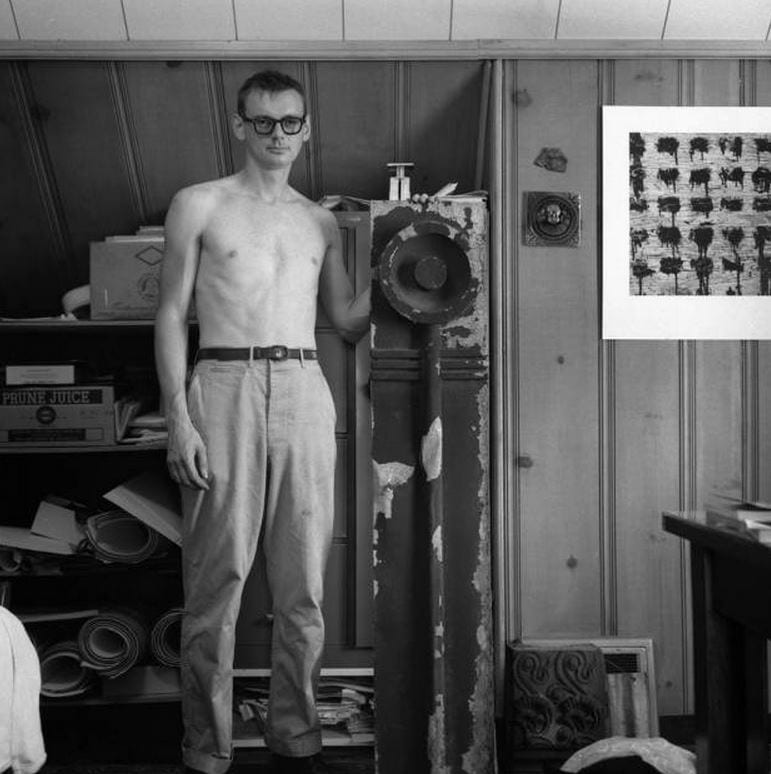
Richard Nickel was born in 1928 in the Polish section of Chicago. Four years prior, Louis Sullivan died in relative obscurity, his buildings falling into disrepair and neglect.
Nickel was born into a city still healing and trying to redefine itself after the Great Chicago fire, according to former Sullivan Collection curator John Celuch.
Unfortunately for Sullivan, his historic buildings stood in the way of the new Chicago of the future. However, the architect had no way of knowing that his work would inspire one son of Chicago to stand up and fight a battle to save his legacy.
In 1948, recently discharged as a paratrooper for the 11th Airborne, Nickel enrolled at the Institute of Design in Chicago after producing photographs and movies of his time in the army. According to Richard Cahan’s extensive biography of Nickel, there were two simple reasons why he decided to go to art school: It was located in his native Chicago, and it was free under the G.I. Bill of Rights.
After serving another tour of duty as a photojournalist in the Korean War from 1950 to 1952, Nickel returned to the Institute of Design where his life forever changed.
Celuch said one assignment in particular became Richard’s obsession, consuming his life.
“In 1953, the young photography student at the Institute of Design in Chicago was given an assignment from his teacher Aaron Siskind, who charged Richard Nickel and other students with the task of identifying and photographing the buildings of architect Louis Sullivan,” Celuch said. “Chicago was losing a ton of buildings at the time. The group would go around the city photographing the works of Louis Sullivan. Richard got really hooked. He started looking further. He ended up on a lifelong quest to document and save Sullivan’s buildings. Richard Nickel was the definition of passionate.”
Yet, for all his passion, Nickel said in writings that at the beginning of his career, he was not only unqualified for the task at hand, but also that he was an unlikely candidate.
“At the start, I didn’t have the proper equipment,” Nickel said. “I had never given architecture a serious thought, and I had never heard of Sullivan.”
University archivist Steve Kerber said the photographer soon realized that his subjects were disappearing faster than he could set up his camera.
“Nickel witnessed these structures designed by Sullivan being torn down. To Nickel, this was a cultural disaster,” Kerber said. “Nickel saw Sullivan as the greatest American architect. He didn’t want to see Chicago and the world lose these architectural jewels. He became obsessed with preserving the work and legacy of Louis Sullivan.”
Nickel said he was fighting a war to save the soul of Chicago.
“It shatters me that we tear down these obvious works of art,” Nickel said . “I’ll fight the goddamn system to the bitter end. Like Dylan Thomas’ poem, ‘Do not go gentle [into that good night].’”
According to a documentary by Margie Newman and Jay Shefsky for WTTW Chicago, Nickel would enter a building demolition site donning a military-style helmet; his weapons: a pickaxe, chisel and hammer.
If Nickel couldn’t save the buildings themselves, he would at least salvage the architectural terra-cotta ornament. Often, the building would be collapsing in around Nickel, yet he would continue to work among the thunderstorm of debris, even more furiously to save these treasures lest they be forever lost to the trash heap.
Celuch said he remembers Nickel’s stories of salvaging ornament at these demolition sites.
“Nickel would go to these demolition sites at really bizarre times, like 2 a.m.,” Celuch said. “Nickel told some great stories about being caught on a demolition site by the police and taken to the station in the middle of the night. He would use his one phone call to get bailed out, and then he would promptly return to the demolition site and continue salvaging.”
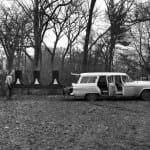
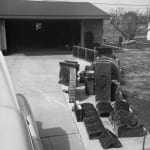
As the ‘50s bled into the ‘60s, Nickel’s collection of salvaged Sullivan ornaments was proving to be more than he could handle. Nickel would transport these pieces in the car trunk from the demolition sites to his parent’s attic, where he lived until his death.
His parents’ lawn became covered with salvage. Nickel even rented space on Chicago’s Navy Pier to store his growing collection.
Nickel desperately needed a home for his collection, Celuch said, yet unfortunately, he did not find it in Chicago, much to his dismay.
“The irony is that the people in Chicago didn’t appreciate Nickel’s work enough to keep it in the city,” Celuch said. “He made attempts to sell his collection to numerous organizations in Chicago, including the Art Institute of Chicago, who turned him down.”
Kerber said Nickel reluctantly found a home for his collection downstate at a fledgling university.
“John Randall was the university architect who worked with HOK, a large design firm out of St. Louis,” Kerber said. “John Randall came from Chicago, and he was acquainted with Richard Nickel. Randall became the proponent for the acquisition of Nickel’s collection. If it wasn’t for Randall, the collection never would have come here. SIUE ended up paying Nickel $12,000 for his hard-earned collection.”
The collection was first displayed in Lovejoy Library in 1966, with Nickel present and involved in the original placement of the pieces.
Celuch, a design student at SIUC at the time, said he attended the gallery opening.
“I remember there were two carloads of design students that came up from Carbondale,” Celuch said. “The opening was something like 7 p.m. at the Lovejoy Library. Nickel was present at the opening, as well as Randall and several others associated with Nickel from Chicago. I don’t remember Nickel talking publicly that night, but I do remember speaking personally with him and Randall.”
Celuch said the opening of the Sullivan Collection proved a turning point in his own life as well.
“I remember John Randall came up to me. Somehow he must have sensed that I was passionate about this stuff,” Celuch said. “Perhaps he sensed that I had been bitten by the same bug that Nickel had been. I kept in touch with Randall throughout my undergrad, and he ended up hiring me as the curator of the Sullivan Collection in 1969.”
Celuch’s work as curator involved working with Nickel, who eventually met his end salvaging pieces for the SIUE collection.
“Nickel continued to collect ornament even after he sold his collection to SIUE,” Celuch said. “Tragically, when Nickel was killed in the Chicago Stock Exchange Building in 1972, he was salvaging ornament to add to the SIUE collection.”
According to Kerber, the collection is unique in the world. There is no other comparable collection of Sullivan’s work than what we have here, and we would not have it without Richard Nickel.
Kerber said, however, that Randall’s original plans for the collection were overzealous to some extent.
“I think Randall took too big of a bite,” Kerber said. “By its very nature, it is a very difficult collection to work with. Most of the pieces were left unused by the university in storage and even outside.”
In fact, only a small portion of the ornaments purchased from Nickel ended up in the library collection . A good deal is kept outside on the lawn in front of the University Museum. Some of the ornaments are sitting in the exact spot where they were dumped more than 40 years ago.
The words of Sullivan ring true as these treasures continue to weather the elements on the lawn of the University Museum season after season.
“And decay proceeds as inevitably as growth, function is declined, structures disintegrate, differentiation is blurred, the fabric dissolves, life disappears, death appears, time engulfed. The eternal life falls…Out of oblivion into oblivion, so goes the drama of creative things.”